Island Peak in 2025: How Climate Change Is Shaping the Himalayan Climbing Experience
Island Peak, Imja Tse to locals, has long been the mountain people go to when they want their first real taste of high-altitude mountaineering. Rising to 6,189 meters above the Imja Valley in Nepal’s Khumbu region, it sits among giants like Lhotse and Ama Dablam. It has long served as a training ground since the days of the 1953 British Everest team. But in 2025, the climb looks very different. Global warming is speeding up glacier melt, exposing loose and unstable rock and turning once predictable sections into treacherous terrain.
The broader Hindu Kush Himalaya is warming faster than the global average, and weather stations around Everest have shown steady increases in temperature and shifting rainfall patterns over the past three decades. Glaciers in the region have thinned dramatically since the 1990s. Even the Khumbu Glacier, the main approach route, retreats unevenly but consistently, challenging the mostly novice climbers.
On Island Peak itself, the changes are hard to ignore. The glacier that once fed the route has pulled back, opening up slopes more prone to rockfall. The headwall, previously a reliable ice climb, now includes steeper, more brittle sections where ice has given way to rotten rock. Guides say they’re anchoring fixed lines into less secure ground each season. Crevasses widen earlier in the year, seracs collapse more often, and thawing permafrost makes the upper mountain feel increasingly unpredictable. Veteran guide Ian Taylor, who has summited more than 25 times, stopped taking clients there altogether, arguing that the risks have surpassed what most novice climbers can manage. Many operators now steer people toward less unstable peaks like Lobuche East.
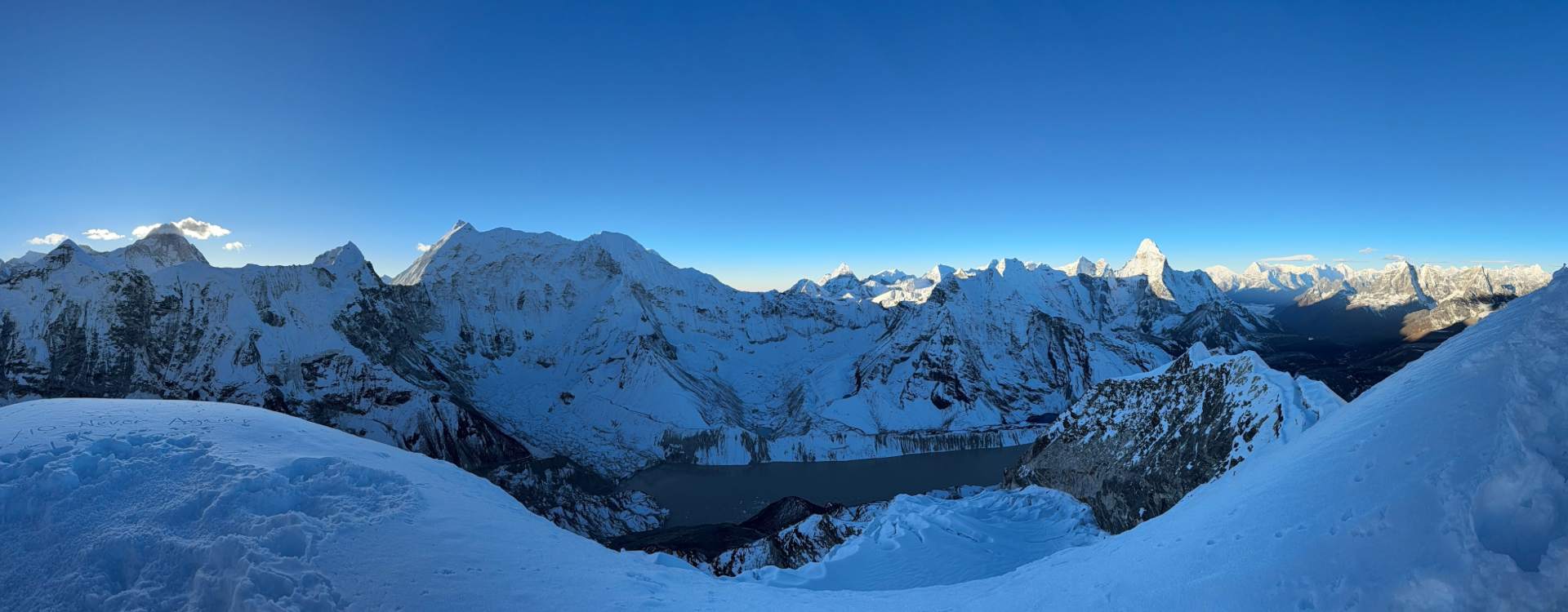
Even the walk to base camp reflects what’s happening in the region. Imja Tsho, the glacial lake beside the trail, formed in the 1950s and grew quickly, crossing one square kilometre by the early 2000s. Engineers lowered its water level by about 3.5 meters in 2016 to reduce the risk of a devastating flood, but the glacier feeding it keeps shrinking. Recent satellite images show the lake stretching farther as the ice retreats, and the danger of sudden outburst floods remains, worsened by rockfalls from weakened slopes, including those around Island Peak.
The Khumbu region overall now sees more erratic weather: storms that roll in without warning, monsoons that behave differently than they once did. In 2024, a glacial lake outburst flood struck Thame, a reminder of how quickly things can go wrong. By 2025, climbers often start earlier to avoid the soft, slushy snow that forms in warmer afternoons, and permafrost melt threatens the stability of high camps.
Climbing practices have had to evolve. Companies now expect clients to arrive with more technical skills, especially for fixed-line work. Teams bring extra rock gear where ice screws are no longer reliable. Some guides shorten summit windows or avoid certain sections entirely. And inexperienced groups see fewer successful summits, not because they’re out of shape, but because the mountain’s objective hazards have increased.
Yet Island Peak still draws people in. Its summit ridge continues to deliver sweeping views of Everest, Lhotse, and Makalu, and the communities around it remain deeply connected to the trekking and climbing culture. The mountain’s appeal hasn’t vanished; it has simply become more demanding. With projections pointing to continued warming and sustained glacier loss in the eastern Himalaya, many of the routes familiar today may look entirely different by the 2050s.
Climbing Island Peak in 2025 offers a front-row view of a changing cryosphere (the shrinking and shifting world of glaciers, snow, and permafrost). The sense of adventure is still there, but so is a clearer awareness of fragility. As one longtime guide put it, “the peak doesn’t forgive mistakes the way it used to.” For anyone heading to the Khumbu this season or the next, the challenge remains, along with the lesson behind it.